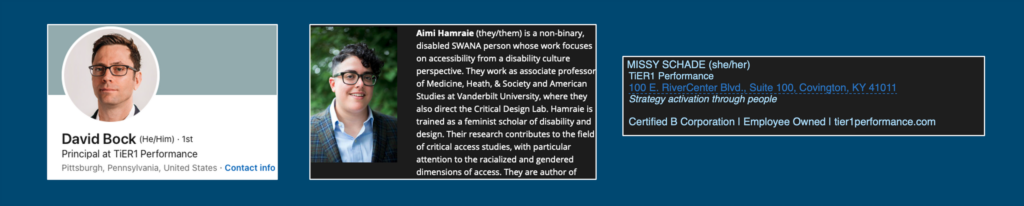
What is new or different about these images and statements? Hmm…why suddenly are you seeing the use of pronouns in Miro boards, email signatures, verbal introductions, and LinkedIn profiles?
As humanity continues to evolve, we uncover more ways to be inclusive of people, specifically of an individual’s identity. Being inclusive of their identity includes recognizing, honoring, and treating them as a whole person.
This is like a few other practices that set the tone of inclusivity, such as:
- Respecting someone’s preferred name when they state it. My name is Victoria, not Vickie; Michael Gibboney is Michael, not Mike; Dr. John Roberts, PhD prefers to be called Dr. Roberts.
- Honoring and attempting the proper pronunciation of a name: Kayan (KEY-yawn) or Karrin (kuh-RIN)
There is power in language; therefore, we share pronouns to ensure people aren’t assuming our gender based on appearance or bias. By stating, “My pronouns are she/her/hers, he/him/his, they/them/theirs,” it sends a signal to others that you are personally aware and open to receiving their pronouns to address them as they prefer. This gives an individual power and agency of their identity. In other words, “You are welcome here!”
Check out this animated video to learn more on gender identity and pronouns:
The Data: evolution of attitudes toward LGBTQIA+ requires diligent workplace inclusion
Around the world dating back to 2000 BCE there are people who identify as non-binary. It’s always existed, rather it’s about societal awareness and acceptance. (If you’d like to geek out on Nonbinary Identity History, click here.) Recent research conducted by The Harris Poll on behalf of Out & Equal revealed how societal perspectives on gender and attitudes towards LGBTQIA+ workplace practices have evolved. A few takeaways include:
- Nearly half of Americans see gender on a spectrum and comfortable using gender-neutral pronouns.
- 7 out of 10 adults believe employers should learn everyone’s pronouns and preferred name to use them in the workplace.
- 1 in 3 adults ages 18-29 know someone who uses gender-neutral pronouns. Millennials now represent the largest share of US labor force and are leading in open-mindedness, inclusive values, and higher rates of LGBTQIA+ identity.
- 1 in 10 LGBTQ workers left a job because the workplace was not accepting.
- In the US there are an estimated 1.4 million transgender Americans.
A Story: my mistake of misgendering during a call
Earlier this year I joined a practitioner circle of talented souls who work within organizations across the US. I joined the Zoom meeting, everyone waved, and in all of my excitement to see this great looking group of racially diverse humans I blurted out, “Hey beautiful ladies!” In that moment, I said it, then scanned the names and saw a participant’s name with (they/them) behind it. My heart dropped – dang, how could I do this, knowing I practice inclusion everyday? So, during my introduction, I made sure to apologize, greet them as “beautiful friends,” and introduce myself with my pronouns.
Guess what? Another practitioner made the same mistake during an introduction and said, “Hey, ladies!” So, I jumped on a backchannel text and said to the host, “She made the same mistake I did when I first joined and said ladies, but I noticed they/them, we have to be conscious of it.” Here is the beautiful thing: we caught it and four meetings later it never happened again. The impact is the individual feels included and respected within our group. We didn’t make a big deal of it; it was all about being conscious of the mistake, apologizing, and continuing on.
The Action: Pronoun usage and gender inclusive language in the workplace
TiER1 is collectively on an IDEA journey to embrace a growth mindset, curiosity, and a commitment to our T1 values to build trusting relationships and help everyone bring their whole selves to work. Shout out to Out & Equal, which has served as a great source of learning as we lean into our IDEA Journey as conscious leaders. Their articles, resources, and toolkits are incredibly helpful. Also, I encourage you to check out the hyperlinks within this article for additional resources to guide your own awareness.
Meetings: When meeting with someone for the first time, I encourage you to take the lead and introduce yourself by stating your name, pronouns, role, then continue. Invite them to use the same format. NOTE: Disclosure is always optional!
For example: Hi, my name is Victoria Rodgers, my pronouns are she/her, and I’m the DEI Strategy Director here at TiER1.
Presentations: For your introduction slides, where we place pictures/names and roles, I invite you to consider asking your teammates to add their pronouns behind their names in parentheses.
For example: Victoria Rodgers (she/her/hers)
Addressing Groups: Here is an open invitation to shift how you address groups from the often used “Hey guys.” Remember, this is a journey. Here are some great alternatives:
- All of you
- Colleagues
- Everyone;
- Friends
- Folks
- Team
- Y’all
Also, check out this article How to Use Gender Neutral Language & Why It’s Important to Try.
Email Signatures & LinkedIn: Add your pronouns to your email signature and use the fields provided in LinkedIn profile and other social media sites.
Get Curious & Learn: Here are some great resources for you to start with:
- Pronouns Guides
- Creating a Trans Inclusive Workplace
- How to Use Gender Neutral Language & Why It’s Important to Try
Give Grace. We all mess up. Rather than make a spectacle of it, address the mistake, apologize or make amends, and show gratitude that someone corrected you.