THE work PERFORMANCE FIELD:
INNOVATIVE IDEAS FROM OUR HISTORY TO OUR FUTURE
We who work in the Work Learning-and-Performance Field are dedicated to helping people and organizations perform at their best. Over the years, innovators have built better methods, have drawn from science and experience, and have looked outside the learning field to add revolutionary thinking to their work. In this interactive, living document written—with our fellow work-performance professionals in mind—we are exploring the forces that are shaping the future of learning in the work-performance context.
THE work LEARNING-AND-PERFORMANCE FIELD:
By Will Thalheimer
With contributions from Jerry Hamburg, Zac Ryland, and others
How This Document Works
Each installment of The Work Learning-and-Performance Field is published in the sections below.
Table of Contents
Executive Summary
Preface
A Focused History of the Work Learning-and-Performance Field
Our Identity as Professionals as It Has Trended Over Time
Today's Forces of Change
The Next Phase: Performance Experience Design
Conclusion and Acknowledgements
Afterword
EXECUTIVE summary
After reading, we invite you to join us in exploring the opportunities and insights shared. Tell us what you think of this article and share your words of wisdom by filling out the form at the bottom of the page. We would also love to learn about other examples of efforts that aim to impact the work-performance context—either directly or indirectly. If there are any lessons learned you’d like to share, or any people or organizations you’d like to point to who are doing great work in doing Performance Experience Design, we want to hear about them. Let’s talk!
We who work in the Work Learning-and-Performance Field are dedicated to helping people and organizations perform at their best. Over the years, innovators before us have built better methods, have drawn from science and experience, and have looked outside the learning field to add innovative thinking to their work. As professionals ourselves, we hope to emulate these innovators—drawing from proven practices, from research inspiration, from our own experiences, from rigorous evaluation—to build effective learning and performance solutions. Sometimes our changes are good, sometimes they fall short, but we do our best work when we are open to learning and improvement.
It is not easy though! Human performance is intricate, confounding, and multifaceted, making it difficult to measure and improve. As we help people do their best work, we accept that we are walking through a world of complexity—one where success requires humility, curiosity, learning, and most importantly, the wisdom to find and deliver the right solution to the right opportunity.
23 Historical Influences on Our Work
In this article, I explore 23 major historic influences on our work—celebrating the innovators and innovative ideas that have enabled our success up to now while also pointing out limitations where they exist.
- Ad-Hoc Guidance
- Apprenticeship
- Standardization for Large Numbers of Learners
- Rote Rehearsals
- Time and Motion Studies
- Operant Conditioning and Positive Feedback
- Systems Thinking
- The ADDIE Model
- Performance Improvement (aka Human Performance Technology)
- The Quality and Process-Improvement Movement
- Prompting Tools (Job Aids, Performance Support, etc.)
- Activity-Based Training Methods
- Andragogy
- The Learning Organization
- Simulations for Learning
- Learning While Working (aka Informal Learning, Learning in the Workflow)
- User Experience Design
- The New Learning Sciences
- Learning Technologies and Digital Learning
- Performance Consulting
- Data Visualization
- Design Thinking
- Online Learning, Online Work, Online Living
The Evolution of Our Professional Identity
No profession stands alone against the backdrop of ever-evolving thoughts and practices. To stay relevant and to maximize our effectiveness, we must reinvent ourselves by bringing in wisdom from new scientific discoveries, from evidence-informed work practices, and from our own efforts in seeing what works and what doesn’t work. Over the past century, we as learning professionals have trended through the following identities:
- Training
- Instructional Design
- Learning Experience Design
Acknowledging that this interpretation is culled from a fuzzy dataset—there are many of us and we have many varied job titles—an overall pattern emerges. Yes, we have also thought of ourselves as doing performance consulting, talent development, human performance technology, and eLearning development—just to mention a few labels we have given our work—but these terms have not been as foundational to our professional identity as the three primary identities.
Why do we as a field move from one identity to the next? Because every so often we look at our work and become dissatisfied with its direction. Let’s think through the list above, starting with training:
We became uneasy focusing on training when we saw that conveying information couldn’t lead to full success.
We became uncomfortable focusing on instructional design when we realized that “instruction” shouldn’t be our only leverage point.
Now we are focused on creating learning experiences to help people do their work. At some point we will look at learning experience design and see that it, too, is not enough.
15 Forces Set to Push Us Toward Our Next Identity
Informed by the 23 historical influences that have informed our work, in this article I will also dive into the following influential forces that may potentially push us beyond learning experience design.
- Working with Habits
- Performance Triggering
- Supporting Remembering
- Performance Preparation, Inoculation, Resilience
- Supporting Insight Learning and Creative Ideation
- Supporting Innovative Perseverance
- Supporting Self-Guided Learning
- Supporting Team Leaders as Learning Ambassadors
- Going Beyond Conscious Intent
- Data Science
- Artificial Intelligence
- Virtual and Augmented Reality
- Improved Learning Evaluation
- Social Responsibility
- Increased Professionalization
The Big New Opportunity
In looking at the totality of these influences, an opportunity emerges that we haven’t fully leveraged in our work doing training, instructional design, or learning experience design. Yes, some of us have dabbled, but as a field, we have not yet parlayed this opportunity into significant work performance improvements.
Our big opportunity is to design for the work-performance context to promote behavior change. We can change the work context directly, which is difficult—and we can also do this indirectly through activities related to supporting remembering, performance triggering, habit formation, performance preparation, inoculation, resilience, leveraging leaders, enabling self-guided learning, promoting insight learning, empowering innovation, and measuring competence during learning. I will discuss each of these areas of influence in some detail throughout the main body of the article.
Performance Experience Design (PXD)
In the article, I will propose that Performance Experience Design (PXD) is the next evolution of our profession—bringing the wisdom we have learned while doing training, instructional design, and learning experience design, and adding a new set of capabilities focused on the work-performance context. PXD utilizes more than learning experiences, bringing multiple competencies to bear including change management, communications, visual design, behavioral economics, technology, organizational culture, and more.
Admittedly, we are just getting started in this evolution. We will move forward only if we join forces in collaboration, utilize rigorous methods of inquiry and experimentation, continue to iterate, make improvements, and are humble and open to new possibilities.
In the next installment of this series, “A Focused History of the Work Learning-and-Performance Field,” Will shares the wisdom we have drawn—and can still draw—from the innovators of the past. Select a section header to continue reading.
PREFACE
How to realize the potential in people is one of life’s biggest questions, and we don’t pretend to have all the answers. Yet, we do have ideas borne by others that can help challenge us, as learning and development professionals, to think deeper, act wider, and focus more on the question: how can we help people do their best work?
Over the years, we’ve seen amazing L&D efforts that successfully ensure people know the “what, when, and how” to do something—and yet, we see gaps in the “do.” Ask yourself: Even when you know what and how to do something, do you always do it—consistently and proficiently? Do you do it when it’s needed most?
Do the employees you serve always do what they know to do? We typically see performance vary in special moments—when customers are angry, teams need leadership, products need to be shipped—and it’s in those moments that doing matters. It’s about performance: consistent, proficient behaviors in the moments that matter. And performance comes, in part, through experience.

In the evolution of our identity, we are being laser-focused on performance. Organizations in every sector, from large global organizations to small nonprofits, all need performance. Performance achieves visions, accomplishes missions, serves people, and helps communities. And so, the name: Performance Experience Design, or PXD for short. PXD helps L&D by focusing mindsets, leveraging models, and using methods to create solutions that help people perform.
We see PXD as revolutionary in intent, and evolutionary in practice. Those who don’t know history are doomed to repeat it. To tell this tale, Will Thalheimer, in this article, describes a focused history of our profession, the forces that are shaping it and our identities, and the opportunities before us—including the invitation to think of ourselves as performance architects and experience designers.
A FOCUSED HISTORY OF THE WORK learning-and-performance FIELD
23 Historical Influences
The history of the work learning-and-performance field tells many important stories—too many to tell here. But still, a short recounting of 23 key influencing ideas will help us imagine what may come next year and the year after—and enable us to be ready for the challenges and opportunities we will face.
This history is simplified to focus on the most important ideas and practices; it is not an exhaustive list. This history also focuses on our industry in aggregate, and likely I’ve missed important personal stories, especially of practitioners who were far ahead of the industry. One final caveat: Given my vantage point embedded in the L&D field in North America, I regret that the perspective here is lacking important international contributions and trends. My apologies for these limitations! I’ve tried to portray a balanced accounting, and I encourage you and others to elaborate on the stories I have missed.
In my efforts to capture major ideas and movements impacting the work that we’ve done and the work that we do now, I landed on the following 23 influencing ideas as well as the benefits and limitations of each idea.
1. Ad Hoc Guidance
Before there was a formal work learning-and-performance field, there were people learning from each other in ad hoc ways: sometimes through observation and modelling, sometimes through coaching, guidance, and answering questions. These are excellent practices, but they are not always sufficient on their own. For example, when tasks are complex, a more scripted and progressive approach is required—such as is seen in apprenticeship. Still, ad hoc guidance should not be dismissed as a thing from the past. People in our organizations today are using these methods spontaneously. We can add value by highlighting opportunities and guiding our fellow employees in best practices.
2. Apprenticeship
The apprenticeship system evolved when task complexity required sustained learning and practice. Apprentices were given progressively more difficult task assignments and were mentored and coached as they progressed to full competence. The term “apprenticeship” may be used less frequently today, but the idea of progressively more challenging tasks is still a vital and powerful practice. Apprenticeship is more difficult as we scale to include large numbers of people in learning and development efforts. Still, we can look to provide progressive challenges in any number of ways—in onboarding, in job rotations, in serious training designs, and so on.
3. Standardization for Large Numbers of Learners
Once organizations began to grow in complexity—and labor markets began to develop—a more organized work learning-and-performance discipline was required. Manuals, classrooms, and chalkboards enabled large numbers of people to be trained at once. This broadcast model had the benefit of information dissemination, but it often suffered from problems of attention fatigue, forgetting, and lack of active responding. It is notable that education followed the same script as we did in training—lecturing to large numbers of students. Despite the limitations of “classroom” practices, there is an economic and limited-resource wisdom to reaching many people at once.
4. Rote Rehearsals
When classroom learning overtaxed the attention of learners, instructors began adding rote rehearsals and quizzing into the experience. These provided benefits of retrieval practice in supporting remembering, but the focus of these activities was too often on low-level knowledge. This created several problems, including knowledge that was isolated from other concepts in memory, and a lack of relevance to work situations. Today, there are few situations where we would use rote rehearsals, though if properly designed—using variety and multiple modalities—repetitions are beneficial in many learning contexts.
5. Time and Motion Studies
In the late 1800s through the early 1900s, folks like Frederick Winslow Taylor and Lillian Gilbreth championed the use of time and motion studies, which broke work actions into their component parts and timed them to create benefits through efficiency and time benchmarks. These efforts ushered in an important new idea—that work, and work situations, could be systematically studied. Unfortunately, time and motion studies led to work system designs that stifled worker judgment and reasoning, while creating dull and monotonous job roles. Still, we would be wise to systematically study work-performance contexts and the way people operate in those situations.
6. Operant Conditioning and Positive Feedback
In the early to mid-20th century, behaviorist researchers, including BF Skinner, advocated for the idea that desired behaviors should be followed by positive rewards, and that tasks could be broken into actions that could be rewarded. While such reward structures can support some types of work—especially where goals are clear and one-dimensional—rewards can also focus action toward inappropriate ends, weaken people’s drive toward intrinsically-rewarding activities, and diminish people’s focus on other important behaviors.
As we learned from decades of research on intrinsic motivation—from researchers like Richard Ryan and Edward Deci — the focus on rewards can be problematic because of all the subtleties involved. For example, rewards act as informational feedback, making it difficult to disambiguate which is important, the reward or the feedback. Despite these issues, there are two very important contributions from this work. First, while we might not want to set up strict operant protocols, we should recognize that people can turn away from situations that aren’t sufficiently rewarding. They may need positive outcomes at least somewhere on their learning journeys to persevere until they reach success. Second, feedback is critical to learning—not just in formal learning, but also in learning from our day-to-day experiences at work and in our lives.
7. Systems Thinking
Systems thinking is a way of observing the world and our organizations—and recognizing that causality is often multifaceted, complex, and interconnected. For us as learning professionals, systems thinking enables us to see that our learners are influenced by organizational systems and subsystems and that learning and remembering are also subject to multiple interdependent factors. One interesting finding called suboptimization, highlighted by renowned economist and operations researcher Charles Hitch, is that optimizing subsystems can lead to poor performance for the larger system. This again highlights the complexity we find in the workplace.
Systems thinking is not a term we use often, but we use systems thinking when we recognize that work contexts matter; that supervisors and coworkers may influence learning application; that we need to satisfy our business stakeholders, not just create the best learning; and so forth. In their book, Conscious Capitalism, John Mackey and Raj Sisodia suggest that “systems intelligence” is a critical skill for today’s leaders. Systems thinking embraces complexity but can also lead to paralysis when we conclude that things are too complex to analyze and comprehend. Despite these worries, systems thinking is aligned with reality—we work in environments of complexity—and we would do well to see both the forest and the trees, learning how to use experimental methods to tease out what works and what doesn’t.
8. The ADDIE Model
The ADDIE Model originated in the 1970s in work done for the U.S. military. It proposes five steps for instructional systems design: Analysis, Design, Development, Implementation, and Evaluation. Often utilized as a waterfall approach—moving from one step to the other without iterating—in the 2000s, ADDIE practices were modified to be iterative and to include evaluation in every step in the process. ADDIE has created benefits in giving learning teams a roadmap for project management. Indeed, it has roots in system engineering from the 1960s, particularly in the phases ascribed to the systems development lifecycle. ADDIE also nicely highlights the benefits of doing full-scale analysis before starting design work.
Yet, ADDIE has two critical limitations. The five steps are project management steps and have no learning wisdom baked into them. We could use the five steps just as easily to plant a garden. Indeed, the original work around ADDIE offered specific learning-related tasks for each step of the process. Many of us focus only on the five labels—Analysis, Design, and so forth—and don’t add wisdom related to learning. This self-imposed limitation is worrisome to the extent that our learning teams may think they are doing good learning development if they just follow the five labels. The second limitation of ADDIE is that when we embrace it as a learning-development methodology, we may end up pushing ourselves toward a training-first solution, which may not be what is needed. The bottom line is that ADDIE without step details is not enough, but the five labels incorporate some notions that we should embrace. We ought to have a good project roadmap, we ought to begin with a serious analysis process, and we ought to utilize evaluation and feedback processes to help us improve our work.
9. Performance Improvement (aka Human Performance Technology)
In the 1960s through the 80s, a major shift occurred in the learning and development field, often attributed to Geary Rummler, Thomas Gilbert, Bob Mager, and other members of ISPI (the International Society of Performance Improvement). These innovators added three critical elements. First, they emphasized that training and development efforts should focus on performance—not learning per se. Second, they recognized that people in organizations are influenced—in a systems thinking way—by forces external to the individual, including incentives, time constraints, resources, etc. Third, they advocated for a performance focus rather than a learning-to-performance focus. Their argument was simple. By focusing on performance first, we will start by examining all the forces impacting work performers—and we will avoid bias toward seeing learning or training as the solution. While these insights are timeless, performance improvement has not been able to fully establish itself as a separate discipline, at least by that name. Instead, it sits heroically and too often underutilized in learning and development—even though its central tenets have been embraced by all, in principle. We would be smart to embrace a performance-first focus in our day-to-day work.
10. Quality and Process Improvement
The quality movement (Total Quality Management, ISO 9000, lean manufacturing, and Six Sigma) emphasized the idea that whole organizations must work together to improve product quality. Aligned with the work of W. Edwards Deming, Joseph Juran, and Kaoru Ishikawa, quality and process improvement focus on minimizing process variability, streamlining processes for efficiency, and empowering employees throughout the organization. Interestingly, despite using sophisticated practices such as statistical process control, this movement has always highlighted the importance of management and the culture of teams and the organization. Geary Rummler built his consultancy around the idea that work processes are a critical target to support organizational improvement. For us in L&D, the quality movement showed us the value of full organizational commitment, a goal we should aspire to today.
11. Prompting Tools (Job Aids, Performance Support, etc.)
In 1991, Gloria Gery published Electronic Performance Support System, a book that changed the learning field. Her critical insight was that not everything had to be trained, and instead some information could be better conveyed through prompting tools like job aids, performance support systems, checklists, and the like. Gery’s work aligned with earlier work by Rummler and Gilbert on “guidance” and Joe Harless on “job aids,” but it was Gery’s book that popularized the whole notion of performance support (which I have labeled “prompting tools” to be more expansive). Gery’s insight also aligns with human cognitive architecture—we know people can’t remember everything and they do better when prompted directly within their performance situations. Prompting tools work great in some circumstances, but too often we don’t prepare people sufficiently to use these tools. Also, prompting tools are not useful in some situations, such as when deeper knowledge is needed to make good decisions, when it is socially awkward to respond with prompting tool in view, or when people are likely to forget they have these tools available. Yet, prompting tools should be considered an important option for most situations.
12. Activity-Based Training Methods
Training and education have often defaulted to a broadcast model, where an instructor broadcasts information, examples, and demonstrations to an audience of learners. In the 1970s and beyond, Sivasailam “Thiagi” Thiagarajan and others began advocating for more interactive training events. Training presentations were augmented with activities, games, role playing, small group discussions, project work, and more. These activities created better engagement and enjoyment, but too often activities were added that fulfilled no learning purpose other than providing a mental break and enjoyment. In my personal conversations with Thiagi and his business partner Matt Richter, they lament that activities are used without a good purpose. Despite the potential for lackadaisical use, activities can provide powerful benefits such as insight, retrieval practice, diverse perspectives, and reinforcement of key points.
13. Andragogy
Andragogy is a learner-centered, humanistic approach to training design. The term was originally coined in Germany in 1833 and developed into a theory of adult education there before being advocated in the United States in the 1960s by Malcolm Knowles. In Knowles’ original formulation, adult learners are fundamentally different than child learners; adults need to be intrinsically motivated, feel autonomous, see the relevance of what they are learning, and given opportunities to learn by doing. Critiques of andragogy have included that the principles are relevant to children too; that autonomy is more useful to those who have deep knowledge and less useful for people with less knowledge; and that not all adults are good at self-motivating themselves to learn. Still, Knowles had a profound impact on our work and andragogical beliefs still carry weight in our work—sometimes for good, sometimes not. We would do well to draw from andragogy’s emphasis on motivation and relevant practice.
14. The Learning Organization
In the 1990s, the concept of the learning organization bubbled up through the work of Peter Senge, Chris Argyris, and others. A learning organization is one that supports the learning of employees in such a way to enable organization-level transformation and improvement. Drawing on ideas from systems thinking, organizational culture, shared visioning, and cognitive psychology, the learning organization idea pushed organizations to focus more on their people and organizational culture aspects of learning and teamwork. This emphasis was beneficial, although sometimes the effort at transformation to a learning organization ignored business realities that were just as important or more important. The first takeaway for us today is that our interventions must recognize the impact of the work culture on the learning process and the work-performance context. Second, where we can go beyond formal learning events, there may be leverage points to enable learning in the flow of work.
15. Simulations for Learning
In the 1980s, “simulation” became a hot topic in learning and development. (I was in the middle of it, as a project manager and simulation architect for the self-described “world leader in business simulation,” the Strategic Management Group in Philadelphia.) Simulations make good sense from a learning perspective. They can provide contextually aligned retrieval practice, spaced repetitions, feedback—all the while being highly engaging and compellingly relevant. The simulation movement eventually gave rise to authoring tools that have enabled us to build branching scenarios, one of the most powerful and value-producing approaches in the L&D arsenal. While simulations are powerful and backed by the science of learning, to be valuable they must emulate—with sufficient cognitive fidelity—the linkage from operative stimuli to decision making. In short, simulations are powerful learning tools to the extent that they truly simulate important contexts and decisions.
16. Learning While Working (aka Informal Learning, Learning in the Workflow)
If the 20th century is marked by a focus on formal learning interventions, the 21st century has ushered in the age of workflow learning. Spurred by the academic work of Karen Watkins and Victoria Marsick and the industry work of Jay Cross, Jos Arets, Charles Jennings, and Vivian Heijnen, these and other innovators began looking for ways that people could learn organically while they worked. This idea—that learning can be improved not just by formal means, but also while people work—is critically important. This is an evolving area, with many weak implementations pretending to be workflow learning. For example, some organizations are providing formal learning in small chunks and calling it learning in the workflow. But lunchtime presentations, microlearning videos, and webinars are not fundamentally different than longer trainings. They are not leveraging the power of the performance context to enable learning. But we shouldn’t be discouraged by these weak attempts. There is likely a goldmine of opportunity in finding learning-in-the-workflow leverage points.
17. User Experience Design
User experience design blossomed in the 2000s with the work of people like Donald Norman, who coined the term “user experience.” User experience (UX) design is a multidisciplinary approach to creating products, processes, services, and events—aiming to create quality user experiences. Critical elements of user UX design include user research, prototyping, and usability testing. One central principle of UX design—often unspoken—is that we as designers can’t assume that we know best; instead, we must seek to learn and test our assumptions every step of the way through unbiased, rigorous testing. This nugget can be lost in drawing from UX design: If we just focus on creating desired experiences and don’t focus on validating their true effectiveness, we will create poor learning designs. This is especially important for the learning field because humans are notoriously imperfect in knowing what works to create effective learning. The discipline of UX design reminds us to research our learners’ work situations, prototype our designs and solutions, and improve our practices based on insights gained through testing.
18. The New Learning Sciences
Enlightened practitioners in learning and development have always sought to incorporate recommendations from learning science into their learning designs. At the same time, there has also been large doses of folk wisdom applied as well—sometimes helpfully, but many times harming learning despite good intentions. Fortunately, starting in the 1970s, learning researchers began compiling highly effective learning methods. These insights began to gain traction in the work-learning field in the 2000s through research translators like Ruth Clark , Will Thalheimer (me), Julie Dirksen, Patti Shank, Clark Quinn, Mirjam Neelen, Karl Kapp, Jane Bozarth, and others—and through popular books such as Make it Stick by researchers Henry Roediger and Mark McDaniel and writer Peter Brown.
These well-researched findings can help learning teams radically improve their learning results. Of course, as with all research, new findings emerge regularly, sometimes causing confusion. Also, research can be taken out of context or misconstrued, so practitioners would be well-advised to seek out the work of research translators before finalizing their design decisions. In addition to learning from the research wisdom, we should also begin to act more like researchers ourselves. Perhaps we don’t have the capacity or resources to do rigorous experiments, but we can find opportunities to do some A-B testing of our work.
19. Learning Technologies and Digital Learning
One of the most important recent changes in the learning field is the successful use of digital learning technologies. While learning technologies have been utilized throughout the last century—from slate boards, to radio, to mimeographs, to laser disks—we have begun a period of exponential improvements through digital and online learning. Sometimes our learning technologies are highly successful, while at other times poor learning designs or technological problems create failed learning experiences. The key to success—as always—is good learning design. We can look forward to continued innovations in learning technology—for example, improvements in online learning that we can’t even imagine today.
20. Performance Consulting
Performance consulting is a practice that aims to help organizations and teams close performance gaps. The recommended process starts by identifying both the current state and the desired future state. From there, the process utilizes a consultative framework to find the causes of the gaps between the current and desired state. Finally, and only afterward, are workable solutions proposed—and training is seen as only one option out of many. The basic process that underlies performance consulting bubbled up from the advances in performance improvement and human-performance technology (1960s-1980s), but it wasn’t until 1995 when Dana and Jim Robinson published their book, Performance Consulting: Moving Beyond Training, that the wider industry began to see performance consulting as a vital tool in the learning-to-performance toolkit.
21. Data Visualization
Data visualization, as the name implies, uses visual methods and elements to bring meaning to collections of data. Data visualization is especially valuable for large and ill-structured datasets. Well-designed visualizations can illuminate hidden patterns, bring focus to fuzzy data, and move us from paralysis to persuasion. One watch-out: Although compelling and sometimes beautiful, data visualizations can push us to forget how we sourced our data, prompt us to ignore data that went ungathered, and nudge us to misunderstand the big picture. Like many things, data visualization is a double-edged sword. If we use it with wisdom, we gain important insights. If we use it poorly, we can create misunderstanding and promote poor decision making.
22. Design Thinking
Design thinking is a process for creating useful innovative products and processes—and is viewed as especially valuable to create breakthrough solutions. Its key components involve empathetic analysis, careful problem framing, bold and expansive ideation, and prototyping. Originating in the 1950s through the work of John E. Arnold, design thinking began gaining traction in the 2000s and 2010s. Design thinking is useful in learning, as exemplified by the book Design Thinking for Training and Development, written by TiER1er Sharon Boller and her co-author Laura Fletcher . One landmine must be circumnavigated. Because we humans are quite often blind to good learning behaviors, efforts to empathize with learners must be done carefully and tested with objective measures of learning. Moreover, we must be careful not to overemphasize learner needs and underemphasize the needs of the organization, coworkers, the community, and environs. Still, design thinking is a powerful tool when we use it to uncover insights and think boldly about possibilities we might not have seen.
23. Online Learning, Online Work, Online Living
Our world as we perceive it is changing radically. More and more we live in a remote cyberworld of online meetings, online commerce, online relationships, and online communities. The COVID pandemic of 2020-2021 accelerated this paradigm shift; necessity being the mother of invention, L&D professionals and others rose to the challenge of making online learning and online work palatable. Major improvements are coming as individuals and organizations build new tools, innovate new strategies, and learn from one another. We are about to enter a golden age of innovation in online living. The possibilities are truly endless. It’s not to say that we as a field won’t take some wrong turns. No one can predict the future, but all of us can have a hand in shaping it going forward.
Going forward—particularly for us as learning and performance professionals—we must keep a few things in mind as we consider how to meet the challenge of online learning. First, and counterintuitively perhaps, we need to recognize that online learning won’t be the only opportunity for innovation as it relates to learning and performance. Classroom training will change. Learning with others will change. Ways of working will change. Learning evaluation will change. The whole ecosystem of learning could radically change—from who supplies learning to who pays for it. We must be open to opportunities, judiciously and with wisdom.
Second, for us to create effective online learning experiences, we are going to have to play the role of explorers. We will need to start a thousand journeys, try things out, and continuously learn—learn by doing, learn from other innovators and innovative ideas, and learn by failing fast (prototyping and improving.
To increase our likelihood of success as we innovate, we need three essential ingredients. We need to draw wisdom from science, wisdom from our own practices, and wisdom from rigorous learning evaluations. Without these ingredients, we will more likely create complacency rather than highly competent performers.
What This History Teaches
The history of the 23 major influences tells two stories. We get a sense of awe at the brilliant work of so many innovators in the work-learning-and-performance field. At the same time, we catch a glimpse of the wondrous complexity of human learning and performance.
From all this, we may develop a renewed humility about how difficult it is to make wise choices in our designs and practices. We may also develop a renewed dedication to our craft, knowing that is up to us to build on this work so we can better serve our learners and our organizations.
The takeaway from our shared history: Without three personal practices—humility, adaptability, and dedication—we will not maximize our contributions to learning and performance.
OUR IDENTITY AS PROFESSIONALS AS IT HAS trended OVER TIME
This type of progression happens slowly, in ebbs and flows. In the snapshot review of the 23 major historical influences, you may have noticed how elements of interconnectedness, overlap, and complexity created momentum, forcing us to rethink who we are and what we do along the way. Let’s suppose that we are at another turning point in the ongoing evolution of our field. If that were the case, how might we see ourselves as learning and performance professionals, and how we refer to our work?
Let’s look at this trend and the forces that are making us rethink our identities.
Training
We focused on training and providing information until it became obvious that, to be truly effective, we needed to add wisdom from science, engineering, and systems thinking—and most importantly, we needed to focus on performance. Even when we were doing training, we needed to be full-fledged instructional designers.
Instructional Design
We did our job as instructional designers until we realized that formal instruction was not the only way to learn. Instead of just instruction, we built prompting tools like job aids and performance support, we crafted knowledge bases of content, we did performance consulting, and we began building learning organizations. Still, the word “instruction” felt constraining and inappropriate; we wanted to support other ways of learning. Informed by concepts such as workflow learning, user experience design, and digital learning, we began to think of ourselves as learning experience designers.
Learning Experience Design
We are now in the age of learning experience design. Perhaps our focus on experiences grew from the wider movement embodied in the “experience economy” of the last two decades. Many disciplines use experience design for customers, patients, employees, software users, and more. Design thinking is part of this movement.
Today, many of us in L&D think of ourselves as building learning experiences. We build communities of practice; we enable asynchronous discussions; we encourage informal lunchtime learning events; and we use tools that enable people to learn from practice, feedback, and mentoring. All these things enable some sort of learning experience.
We also sometimes go deeper toward performance by designing repositories of knowledge and microlearning objects that learners can access while they are performing. We nudge managers to create better learning cultures within their teams so people can learn while they work together. We set up structured mentoring programs that focus on developing targeted competencies. With these types of efforts, we’re going beyond creating learning experiences to ensure that people in these learning experiences are fully engaged in actual work.
In thinking about ourselves as learning experience designers, our focus has been on creating learning experiences that immediately, or later, support performance.
But is this the end of our evolution? Will we think of ourselves as learning experience designers forever? The obvious answer is no! Something new always comes along. Someday, when enough new ways of working grab our attention, we will be compelled to evolve and refine our practices. We will want to think of ourselves not as learning experience designers, but as something else. So, let’s do the work now—the hard work—to understand the forces on the horizon that may influence us to move to the next step in our evolution.
TODAY’S forces OF CHANGE
- Working with Habits
As humans, we learn quickly that it’s hard to get rid of bad habits and form beneficial new habits. As L&D professionals, we see that some employee work behaviors are difficult to change. Through the research of Wendy Wood, BJ Fogg and others, the science of habit formation and change has really solidified over the last 25 years. Where willpower often fails, habits can be formed by connecting situational cues, actions, and outcomes. Habit formation isn’t easy, often requiring sustained effort over several months—and habits aren’t required for all skills or actions. Nevertheless, where habits are critical to performance, we ought to utilize this relatively new science to support our learners.
- Performance Triggering
We do not live in a world of abstractions. We live in a world of situations, context, and stimuli. The stimuli we encounter trigger our thoughts and our actions. We see a cute kid, we smile. We see a rat at our feet, we jump. We immerse ourselves in a warm bath embraced in the cozy heat of hot soapy water, we relax. In some ways, the situations we encounter control our thoughts, emotions, and actions—or at least strongly influence them. We are triggered to performance. When behavioral economists report that 80% of our neighbors have enrolled as organ donors, we are triggered to become organ donors ourselves. When traffic engineers narrow our streets, we are triggered to slow down as we drive. When our cafeteria puts fruits and salad at eye level and puts the junk food just above the floor, we are triggered to eat more healthy foods. When we put our tasks on calendars instead of to-do lists, we are triggered more often to do those tasks. The idea of performance triggering, popularized in part through the book Nudge by authors Richard H. Thaler and Cass R. Sunstein, brings new opportunities for us in learning and performance. On the other hand, it may be difficult to gain access to people’s work-performance situations—so we may not always have the leverage to manipulate contextual cues directly. We can, however, enable triggering by helping people influence their own reactions to the stimuli they will encounter.
- Supporting Remembering
It’s not enough to help our learners fully comprehend some learning content. If they can’t remember what they’ve learned—or can’t remember what to do on the job—we have not done enough. We must do more than create learning; we must minimize forgetting and maximize remembering. Fortunately, there are research-based learning approaches that specifically support long-term remembering. We can provide learners with context-realistic practice and conceptual repetitions spaced over time.
- Performance Preparation, Inoculation, Resilience
When people have learned successfully—even if they have been primed to remember what they’ve learned—they still must take what they’ve learned and apply it at the right time, in the right context, and in ways that are appropriate. Let’s be real. Some people will hit obstacles, face resistance, or have their motivation wane. Accepting that difficulties are inevitable, there are things we can do to prepare people for the situations they may face, inoculate them to persevere against anticipated difficulties, and enable their resilience.
- Insight Learning and Creative Ideation
In almost all our L&D efforts, we aim to create transfer learning. That is, we hope that concepts and skills are transferred from some person, program, or repository into our learners. What we hardly ever do is to support our learners in creating their own insights. Fortunately, there is a scientific literature on creativity and creative ideation we can draw from—enabling us to support insight learning, not just transfer learning.
- Innovative Perseverance
Good ideas are not worth much unless those ideas can be nourished, supported, improved, and embraced by a wider audience. Fortunately, there’s a science and practical playbook for moving from ideas to innovation. We likely have more leverage than we think in being able to create work environments where ideas can become innovations. We should look for opportunities, especially when innovation is critical to our organization’s success.
- Self-Guided Learning
Some people are brilliant at motivating and guiding their own personal learning and development. Most of us, me included, can do a better job in our own development—by learning how to learn, by getting better tools, or by being in situations and contexts where self-guided learning can happen more easily. We as learning professionals should see where we may leverage our work to support others in learning.
- Team Leaders as Learning Ambassadors
People who lead teams in organizations—whether they have formal authority as managers or informal influence—are critical in team functioning and individual learning. They help set the learning culture, whether they intend to or not. Many L&D teams already do things to support these team leaders, but certainly, we can do more. The concept of leadership development still resonates as organizations look for ways to maintain and improve productivity, loyalty, motivation, and more. As learning professionals, we should look for ways to improve leadership behaviors—not just through training, but through tools, practices, and other ways to leverage the work-performance context.
- Going Beyond Conscious Intent
The common assumption is that people learn only when they intend to learn—and they act only when they make conscious decisions to act. However, the truth is more complicated. Much of human behavior is automatic, not involving conscious intent at all. We’ve already seen how we can trigger performance directly, often with little involvement of conscious intent. There are likely other opportunities where we can leverage non-intentional processes for learning and performance.
- Data Science
Data science comprises many sets of tools and competencies: computation and reporting, algorithms, process simulation, statistical analysis, machine learning, and more. Commerce, business, and communication are all built on data. Learning will not be untouched. Great promise awaits our ability to marshal our learning and performance data. In recent years, using labels like learning analytics or learning engineering, many people are thinking deeply about how to use data to support learning. This will be tricky, however, and we will make mistakes. We may measure what’s easy to measure, not what’s important. We may make decisions based on meaningless data. We may waste time chasing unicorns. We can and will find useful data today, but we must be careful in our work. We should be open and hungry to find or create learning data to guide our work—treading carefully to avoid the traps and trappings mentioned above.
- Artificial Intelligence
Artificial intelligence (AI) is a diverse field of applications and tools; for our purposes, we can define AI as the ability to use computer systems to look for patterns in large data sets, draw conclusions from that data, and make decisions based on the data. AI has been an evolving field since the 1950s when well-known giants in early computing—Herbert A. Simon, John McCarthy, Marvin Minsky, Allen Newell, and Arthur Samuel—began building AI applications. Progress in AI has grown in spurts as emerging technologies and approaches enabled progress. AI has shown clear benefits in some areas, while being less than effective or harmful in some cases. For example, AI trained on current data often “learns” and uses the same biases that we humans have been prone to utilize. Today, in the learning field, most of us simply don’t have large data sets. Without large data sets, AI is not really feasible, except in mundane applications. Going forward, to gain benefits from AI, we must understand its strengths and limitations, and circumnavigate the problems it can bring. Still, someday soon it is likely that AI will have profound impacts on learning, but not just learning! Indeed, before AI is significant in learning, it is likely to improve people’s workplace tools—for example email, scheduling, and personal productivity tools. AI may not be one of our main competencies today, but we should remain open and prepare ourselves for the opportunities it will bring.
- Virtual and Augmented Reality
Virtual reality (VR) immerses us in simulated situations. Augmented reality (AR) helps us interact with our actual reality by enhancing our perceptions of that reality. Today’s most common augmentations include visual overlays of information or objects, but auditory and kinesthetic stimuli may one day provide benefits as well. VR has great potential to help us create learning simulations—although the costs are likely to remain high and may be suitable only for critical or highly utilized learning needs. AR has great potential to help us support people directly in their work performance contexts. In short, VR and AR will certainly impact the learning and performance field, and we should be open to opportunities and innovations provided by these technologies.
- Improved Learning Evaluation
Another opportunity for us in learning and performance is improving our evaluations. We make a ton of mistakes in the way we measure learning. The once dominant Kirkpatrick-Katzell Four-Level evaluation model mashes all types of learning outcomes into one bucket: Regurgitating trivia is learning. So is recall of meaningful knowledge. So is decision-making competence. So is a full demonstration of task competence. Unfortunately, what happens in practice is that we measure what is easy to measure, not what is most meaningful to measure. We provide knowledge checks, but by doing this, we fool ourselves into thinking we’ve created learning—when we may have only created a momentary change in knowledge. Fortunately, and I admit bias of authorship, there is a new evaluation model, the Learning-Transfer Evaluation Model (LTEM). The LTEM framework is valuable because it not only guides us to better learning evaluations but also nudges us to better learning strategies and designs. LTEM is just one way to improve learning evaluation. If we can improve our ability to gather valid information, we will be able to create virtuous cycles of continuous improvement—and this will create a cascade of changes in our work.
- Social Responsibility
Another force arising outside L&D is an emphasis on social responsibility. Organizations are focusing more on responsibility to all stakeholders, not just shareholders, as they seek to reduce pollutants, minimize environmental disruption, source from sustainable materials, reduce energy use, support the health and safety of employees and communities, avoid bias in hiring and promotions, and more. Even corporate interests are advocating against a singular focus on profits. The Business Roundtable, a group of large-company CEOs, have issued their Statement on the Purpose of a Corporation, that it should benefit the interests of a wide range of stakeholders, including “customers, employees, suppliers, communities and shareholders.” In 2021 Larry Fink, CEO of Blackrock, the world’s largest investment company, said they would stop supporting company managers whose companies aren’t taking actions aligned with environmental sustainability. He essentially argued in his letter to CEOs that investment risks were too high for companies that were not taking the climate crisis into account. It appears that momentum is growing for organizations to take drastic steps to realign all their practices around sustainability and social responsibility. We in L&D will be asked to do our part. In the learning and performance field, Roger Kauffman was an advocate for L&D professionals to look beyond business results when we do learning evaluations. LTEM, my evaluation model, specifically directs us to consider measuring the impact of learning on “learners, coworkers/family/friends, organization, community, society, and the environs.” These quiet admonitions have mostly been ignored, but perhaps the need for us to move more forcefully is upon us.
- Increased Professionalization
There’s a quiet movement in the work learning-and-performance field. More of us are using evidence-informed practices, utilizing learning evaluations to create feedback loops that enable cycles of improvement, and creating proactive processes rather than being order takers. We are beginning to be driven by professional principles and practices, rather than just following recipes and directives. It won’t happen overnight, but we are readying ourselves to have a different type of relationship with senior organizational leaders—more of a partnership based on the respect we earn as a professional field. As we move in this direction, we will have more leverage to do our work and more reach into the day-to-day workplace—enabling us to be more effective in supporting work performance.
These Forces of Change Put into Context
It’s impossible to know which of these 15 forces of change are most important, how they might combine in unique and unforeseen ways, or what factors may be missing. Nevertheless, a new focus seems to be emerging from this list—a focus on the work-performance context. Where we have historically focused on creating instruction, prompting tools (like job aids), and learning experiences, these 15 forces suggest an important new set of opportunities: if only we focus more on the experience of people in their work-performance situations.
Most of the 15 influences are set in, or target, work-performance situations:
- Habit formation requires some connection to situational cues—as found in work-performance contexts.
- Performance triggering involves manipulating work-performance stimuli or the way they are interpreted and action-planned.
- Remembering can be a general goal but can also target specific work-performance contexts.
- Insight learning is relevant not in the abstract, but when related to real work issues.
- Creative ideation and perseverance in innovation are similar—they are relevant to specific work opportunities.
- Self-guided learning is relevant to people’s lives and their work, but our efforts will tend to focus on their work performance.
- Team leaders lead at work.
- Automatic unintentional thinking happens everywhere but can be leveraged in work situations.
- AI will have its earliest impact in people’s work tools.
- VR may help us build performance-focused simulations. AR may help us support people in their work contexts.
- Improved evaluation approaches will ensure that learning is performance focused.
- The push for social responsibility initiatives in organizations will, hopefully, influence the way works gets done.
- With increased professionalism, we will have more leverage to reach into work situations to support behavior change more fully.
These examples demonstrate how the work-performance context is central to behavior change and improvement. And more urgently, the examples tell a story—that these areas of influence are impacting us today and will impact us even more tomorrow as enlightened organizations utilize them to competitive advantage. These forces of change are laying the groundwork for the future of the learning-and-performance field; we would do well to begin using these new opportunities for the benefit of our learners, organizations, and others we serve.
Like any new endeavor, this shift will not be simple. We will have to innovate new methods, while utilizing and improving methods suggested from research and from others’ practical efforts. Still, it does suggest a new opportunity for us and a new direction—and maybe a new name for what we do.
THE NEXT PHASE: performance EXPERIENCE DESIGN
My colleagues at TiER1 have been on this journey for a couple of years—long before I became a member of the TiER1 team. Indeed, spurred by the leadership of Jerry Hamburg—who coined the term a couple of years ago—my TiER1 colleagues have been using the label Performance Experience Design for their efforts in building learning and performance solutions for organizations in a wide variety of fields, including healthcare, pharma, manufacturing, retail, technology, restaurant and hospitality, logistics, automotive, military, and more. And to give credit where credit is due, back in 2012 Clark Quinn, my friend and research-to-practice expert, used the term Performance Experience Design because he worried that the term Learning Experience Design would keep us focused on courses rather than the performance goals of the organization.
I’m not a person who embraces every new term that comes along; indeed, people have told me I’m somewhat of a curmudgeon in this regard. But I’ve liked the term Performance Experience Design—PXD for short—since I heard it the first time. It focuses on performance contexts while also embracing wisdom from the work we have done as trainers, instructional designers, and learning experience designers.
Below is a list of some of performance experience design’s imperatives. See if you think the name PXD fits these performance priorities:
Our focus is to support people in their work-performance contexts.
We acknowledge that contexts and the experience of those contexts work together to influence work performance.
We recognize that we are on a journey; that we must continue to learn; that we must collaborate across a wide range of people and interests; and that we must innovate, experiment, and proactively look to make improvements.
We build and utilize evaluation systems that are appropriate to this new focus.
Where appropriate and through diverse perspectives, we look to leverage the following practices:
- Shaping work-performance experiences so they elicit desirable behavioral change.
- Leveraging the routines, rhythms, and rituals of the organization.
- Building prompting tools, like job aids, performance support, signage, reminders, etc.
- Preparing people for their performance situations, providing practice, anticipating obstacles, and building resilience.
- Leveraging the social influences that shape the performance landscape from within teams, units, the organization, and the community.
- Building knowledge/skill repositories that are work accessible.
- Building learning experiences that effectively support remembering and application.
- Building and enabling learning-in-the-workflow experiences.
- Helping people learn how to learn.
- Creating memorable principles, stories, and phrases to shape conversations, attitudes, and behavior.
- Identifying and removing competing commitments to enable people and teams to push through to their desired results.
- Working to support both individuals and organizations, embracing the tension that sometimes arises in creating value for all stakeholders.
Performance Experience Design (PXD) is a multidimensional approach to helping people do their best work, utilizing the tools you and I already use as instructional designers and learning experience designers—but going beyond that in two fundamental ways. First, PXD focuses more on the work-performance context, preparing people to act through both intentional and subconscious processing. Second, PXD utilizes more than learning experiences, bringing multiple competencies to bear including change management, communications, visual design, behavioral economics, research, technology, organizational culture, and business analysis.
Of course, each of us—along with our organizations—will have to decide if Performance Experience Design is the right label for what we do, or what we aspire to do. My colleagues at TiER1 are very circumspect, having an abiding faith in pushing forward, gathering insights, making improvements, learning from clients, learning from work, and learning from the world. They are rightfully proud of their research and discoveries, and the work and solutions they’ve produced, but they’ve also told me that PXD is a journey for them—that they are still learning. Now I am learning with them.
Sidebar: What Do We Call Ourselves?
With instructional design, we called ourselves instructional designers. With learning experience design, we called ourselves learning experience designers. But can we call ourselves Performance Experience Designers? Maybe! But maybe not! One potential issue is that, without any connotation of “learning” in the label, we will create confusion when we post jobs, network outside our profession, or try to explain what we do to our parents or kids or party guests.
“I’m a performance experience designer.”
“Oh really, which kind? Travel adventures, choreography, athletics, or meditation retreats?”
Let me propose a solution: We do performance experience design, and we call ourselves learning-and-performance architects.
A couple of years ago, I advocated that we call ourselves “learning architects.” Others have suggested we should be “performance architects” or “learning-and-performance architects.” The architect framing is nice because it connotes that while we can’t control work performance on a moment-to-moment basis, we can build foundations and structures where productive behaviors are more likely to arise than if we hadn’t done anything.
It’s not easy to select a good name. Indeed, there may be legal reasons we can’t use the word architect in some places. The good news is that this is not a debate that we are seeking to win here and now. Labels gain momentum for many reasons—so over time the market will decide, then later, it will decide anew. My hope is that this naming issue is the least important part of this big opportunity facing our industr
conclusion AND ACKNOWLEDGEMENTS
As professionals, we help other people do their best work and we help organizations thrive. By so doing, in our way, we help make the world a better place.
With this as our mantle, we cannot afford to get stuck in small battles. We must focus on making ourselves as productive and effective as possible. In this article, I hoped to celebrate the innovators and innovative ideas that brought us to today, while also urging us to be open to the next wave of opportunity. The best of us have brilliantly mastered our roles as trainers, instructional designers, and learning experience designers—but now the next vanguard is leveraging the performance experience context.
Perhaps it would be helpful to talk about the evolution of our field using the common—if a bit cliché—method of MS-DOS labeling, i.e.:
- L&D 1.0 – Training
- L&D 2.0 – Instructional Design
- L&D 3.0 – Learning Experience Design
- L&D 4.0 – Performance Experience Design
I’m ambivalent about this labeling, and I leave it to you and others in the field to decide whether this is useful. It seems that, as a field, learning and development (L&D) would really need a new label, something more focused on performance. (Indeed, throughout this document we refer to the “work-performance” context and the “work learning-and-performance field.”)
Wherever we are now, whatever the label we land on, let us begin the journey toward more effectiveness today!
Acknowledgements
As with all things, others have made significant contributions. Let me first thank the many innovators who have come before us—some mentioned in this article, but hundreds who were not. Let me also thank today’s innovators who are pushing us to new conceptions of what is possible.
Special thanks to Jerry Hamburg, my TiER1 colleague and performance-savant who has been passionately waving the flag on these issues for years! Thank you to Jerry along with Zac Ryland and Josiah Holland of TiER1 for providing wonderfully illuminating feedback on an earlier draft, helping me improve this article immeasurably. Special thanks to Kaitrin McCoy of TiER1 who led the effort to edit and improve my words and the structure of this work. Amazing improvements, Kaitrin! Thanks also to TiER1ers Carlina Scalf, Katie Coburn, and Sarah Ehrnschwender for substantive suggestions for improvement!
Also, thanks to the whole TiER1 team who have made it easy for me to jump in, feel valued, be supported, and be encouraged to explore and learn and push things forward—like in this article.
Gratitude to the following collaborators:
- to Guy Wallace—amateur historian of all things “human performance technology”—who answered my many questions with patience and precision, schooled me bigtime on the history of our field, and pointed me to some important articles on his HPT Treasures website.
- to Julie Dirksen, who enlightened me on several of the historical forces reviewed in this article.
- to Matt Richter for providing feedback and helping me see several historical forces I had missed.
- to Alex Salas for his work compiling research on the history of ADDIE—without which I would not have known that ADDIE adherents worked to break the overreliance on the waterfall approach in the early 2000s.
- to Carl Binder for hosting a great library of articles that enabled me to walk through some important history
- to Clark Quinn for talking with me about his thoughts on the term Performance Experience Design and more generally on the goal of performance improvement.
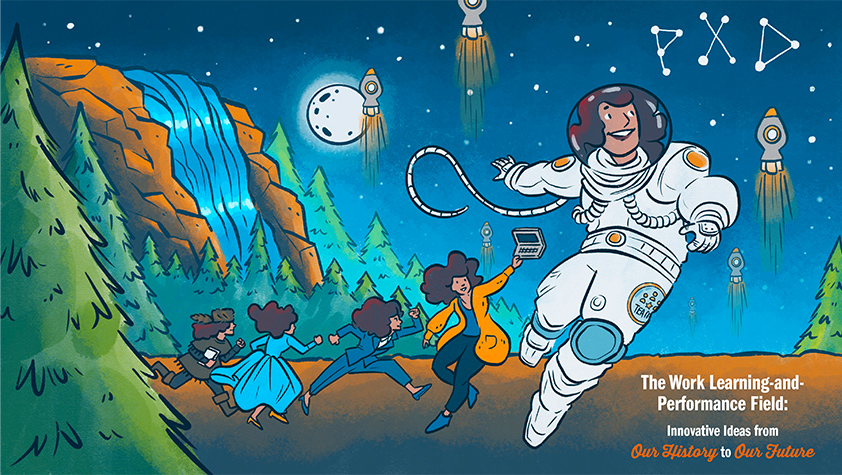
- to Jackie Crofts for her beautiful illustrations accompanying this article and embedded in our workshop slides.
Finally, let me thank you in advance, if you can, for sharing your thoughts and reflections with me and with the public—so we can learn together.
AFTERWORD
Members of our field will tell you they can still name some of their favorite pieces of research, models, or tools that pushed their thinking forward. (For me, it’s Understanding by Design by Grant Wiggins and Jay McTighe.) We love to “nerd out” about things like andragogy, ADDIE, and the spacing effect. And it was a chance conversation, with a random stranger, on methods of engagement and learner progress that introduced me to my current employer. In these ways, we’re a community, a network, or a united coalition. Heck, we might as well adopt a visual cue, not unlike the way Jeep owners wave at each other, to signify membership in the Jeep-drivers’ community.
When I find a member of our order out in the field – whether at an ATD Learning Leaders meeting, or at a client site within an L&D team – I instantly feel a shared and mutual respect. If you’re reading this article, you likely know the feeling and you “get me.” Working in this space (the learning-and-performance field) means we have a love for people and we want to support them in doing their best work. It’s the very thing that drew me to TiER1, an organization where we say our vision is “potential realized” and our purpose is to “build a better world” while keeping a straight face—and we mean it.
Our desire to keep learning and better ourselves stems from more than just the satisfaction of learning something new—it’s also driven by the barriers to performance we still encounter after all these years. I’ve seen how, even after wonderful learning experiences, there are still times “back on the job” where there’s a failure to translate that knowledge into action. This frustration drives us to different places: Some in our community double down on learning methodology and find new ways to apply it; others flinch away from identifying with “learning” and try to associate with other fields like Design Thinking; and sadly, there are those who try to ignore the problem or ignore evidence of it.
Personally, I’ve dabbled in all those crises of identity. Regardless of where you stand today, Performance Experience Design is in response to those insights. PXD is our way of articulating both an evolution in our field and a movement for our end users/performers. We know that knowing doesn’t equal doing and have faced it in our own work. We also know that the integration of “learning” within the business is limited by our ability to drive behavior change and results. As much as we want to create learning cultures in our organizations, learning simply for learning’s sake will never be quite enough.
So when Will Thalheimer, a respected voice in our field, validated those feelings with a deep understanding of the history of our field, I took notice—and I hope you did too.
We know that driving performance and behaviors is much more complex than simply driving learning, that performance objectives and performance outcomes are harder to accomplish than learning objectives. We hope you’ll join us in the next evolution of our work—focusing on the work-performance context, forming new habits, crafting social interactions, igniting the power of meaningful phrases, designing in evidence-based ways, designing for data collection loops, changing the environment and ways of working, balancing the needs of the individual and organization, and more, so much more that will come through your contributions and collaboration.
We’re at alpha. Early prototype. There’s something here, something that has been a thread through all the evolutions in our field over the years—driving performance. We’ll need to crush some bugs, enhance some features, and iterate. Yet, PXD is giving me that same gut feeling, Spider-Sense, or intuition that I get when something has caught the attention of the lifelong learner inside me. I think it will give you that sense too.
Here’s to my vision: that in 2035, Performance Experience Design will have been a focus that defined a decade of helping people do their best work. And that it was possible because a community of professionals (that I long admired, became a member of, and walk with today) challenged, adopted, and improved it.
We invite you—regardless of your organization, your experience, or your job title—to join us in exploring the opportunities in Performance Experience Design.
JOIN THE CONVERSATION
We invite you—regardless of your organization, your experience, or your job title—to join us in exploring the opportunities in Performance Experience Design. Tell us what you think of this article; share your words of wisdom with Will and the TiER1 team by filling out the form at the bottom of the page.
We would also love to learn about other examples of efforts that aim to impact the work-performance context—either directly or indirectly. If there are any lessons learned you’d like to share, or any people or organizations you’d like to point to who are doing great work in doing Performance Experience Design, we want to hear about them!
SOME OF THE THINGS ON OUR mind.

Pervasive Inclusion: The Role of Learning in DEI
TiER1 Affiliate Contractor Victoria Rodgers sits down with learning expert Imani Mance to discuss how pervasive inclusion can cultivate a sense of belonging for learners.

“The Great Resignation” Has Elevated Our Need for Humanity at Work
It’s an employee-driven market now, and they’re looking for more authenticity, trust, and connection. Can you deliver?

Choosing the Right Learning Tech for Your Company
Explore the differences between top learning platforms and tech to decide which best meets your company’s needs.
READ MORE »