What’s trending in the learning and development field in 2024?
We conduct an annual Learning Trends Survey to provide a comprehensive summary of industry trends for the learning and development (L&D) field. We survey L&D professionals on their current practices and the trends that are impacting their teams; then we analyze and compile the data into a report that enables learning teams to benchmark their practices against the industry.
The experts in this EXLEARN Talks episode discuss the data compiled from our 2024 Learning Trends Survey, including data on the impact of Generative AI, employee experience in L&D, learning evaluation, and learning design methods. They provide insight on the following questions:
Impact of Generative AI
-
- 6:08: A lot of organizations are investing in AI but the survey data shows that it’s still not a top priority in 2024. What are some of the barriers to adoption of AI?
- 8:59: How will AI change how we work three, five, or 10 years from now?
- 11:39: Do you have advice for practical application of AI and how to stay ahead of the trend?
Employee Experience in L&D
-
- 16:09: What are the key aspects of employee experience?
- 18:05: How should an organization approach onboarding tenured employees who are new to the organization but bring with them a lot of expertise and experience?
- 21:35: What happens to an organization’s culture when employees don’t choose to keep learning and growing?
- 24:01: How can organizations build a culture that encourages and supports continual learning?
Learning Evaluation
-
- 33:45: How can organizations drive holistic measurement for learning evaluation?
- 36:20: What best practices are you seeing in the learning evaluation space with our clients?
- 39:23: What data should organizations collect to achieve more holistic measurement beyond participation and satisfaction scores?
Learning Design Methods
-
- 46:11: Where is L&D headed if the survey data shows that it hasn’t changed much?
- 48:48: What’s one design/development methodology step or tool that organizations should start incorporating today regardless of the process or methodology they use?
- 52:47: What’s on the horizon for the learning field that people should be thinking about?
- 54:27: What advice do you have for L&D groups that want to create more value for their organization?
Use our 2024 Learning Trends Webinar Graphs PDF to follow along as the experts reference survey data throughout the webinar. We’ll continue to accept responses for 2024 Learning Trends Survey through the end of the year. Take the survey today to share your insights!
Highlights from the Panelists:

“Start using [AI] however you can. Use it with your children to generate brand new bedtime stories week to week. Just come up with fun, innovative ways to engage with [AI] and then your brain will start connecting the dots with the [potential] business applications.”
– Emanuel Lewis, Technology Strategist at TiER1 Performance

“Both the culture of an organization and the employee experience of a human being can suffer when people don’t have time or attention for learning. Learning can sometimes feel like a nice-to-have and not a must-have amid all these different obstacles and resource constraints. [Learning] can fuel our skills, confidence, capabilities, and all the things that we need to manage those uncertainties, and it becomes a must-have instead of a nice-to-have for ourselves and the culture of the organizations we’re working at.”
– Allison Abayasekara, Culture Strategist at TiER1 Performance

“To do more holistic, comprehensive measurement, you need stakeholders to understand there’s more than just [customer satisfaction scores], completion, and participation… It’s important to recognize that stakeholders have different perspectives on what success is and help them understand that [holistic measurement requires] mapping between the learning that occurred and the outcome they’re looking for… When we do more comprehensive learning evaluations, [a lot of the work involves] expectation setting and [helping] stakeholders understand you don’t just move easily up and down these hierarchies of measures—there’s a story that has to be articulated.”
– Walter Warwick, Research Director at TiER1 Performance

“The number one thing that I like to center on is understanding my learner and being as empathetic to them as I can be. Learner personas and empathy mapping—those design thinking tools where you’re trying to gain deep insights into the individuals that you serve as a learning professional—can be really helpful. If you’re using ADDIE today, there’s no need to change; you can simply incorporate some of [those tools] into the analysis and design phase. Dive deeper [by] doing interviews with learners to understand their needs… You still have to understand the business outcomes [you’re working toward], but if you start incorporating design thinking into your upfront work, you’re going to see a lot of success on the backend.”
– Kristen Hewett, Learning Strategist at TiER1 Performance
A Visual Capture of the Discussion:
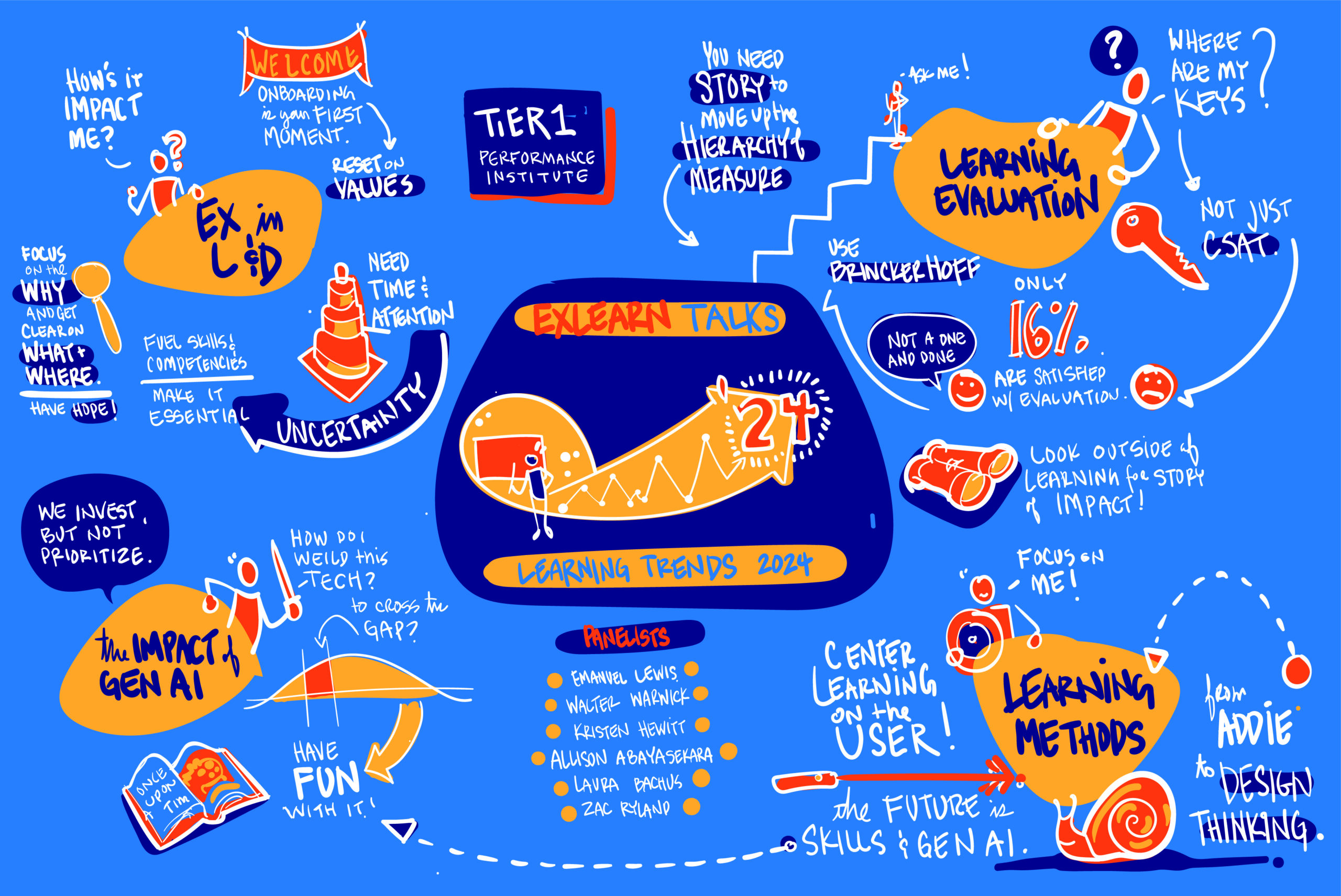
Designed by Ramsey Ford