
Why is it important to measure employee engagement?
Understanding and supporting employee engagement is paramount for boosting productivity, retaining talent, and building a healthy culture. While collecting data can help organizations assess employee engagement, the real goal of measuring engagement is to understand how employees are experiencing their work so that organizations can provide the support and resources they need to thrive.
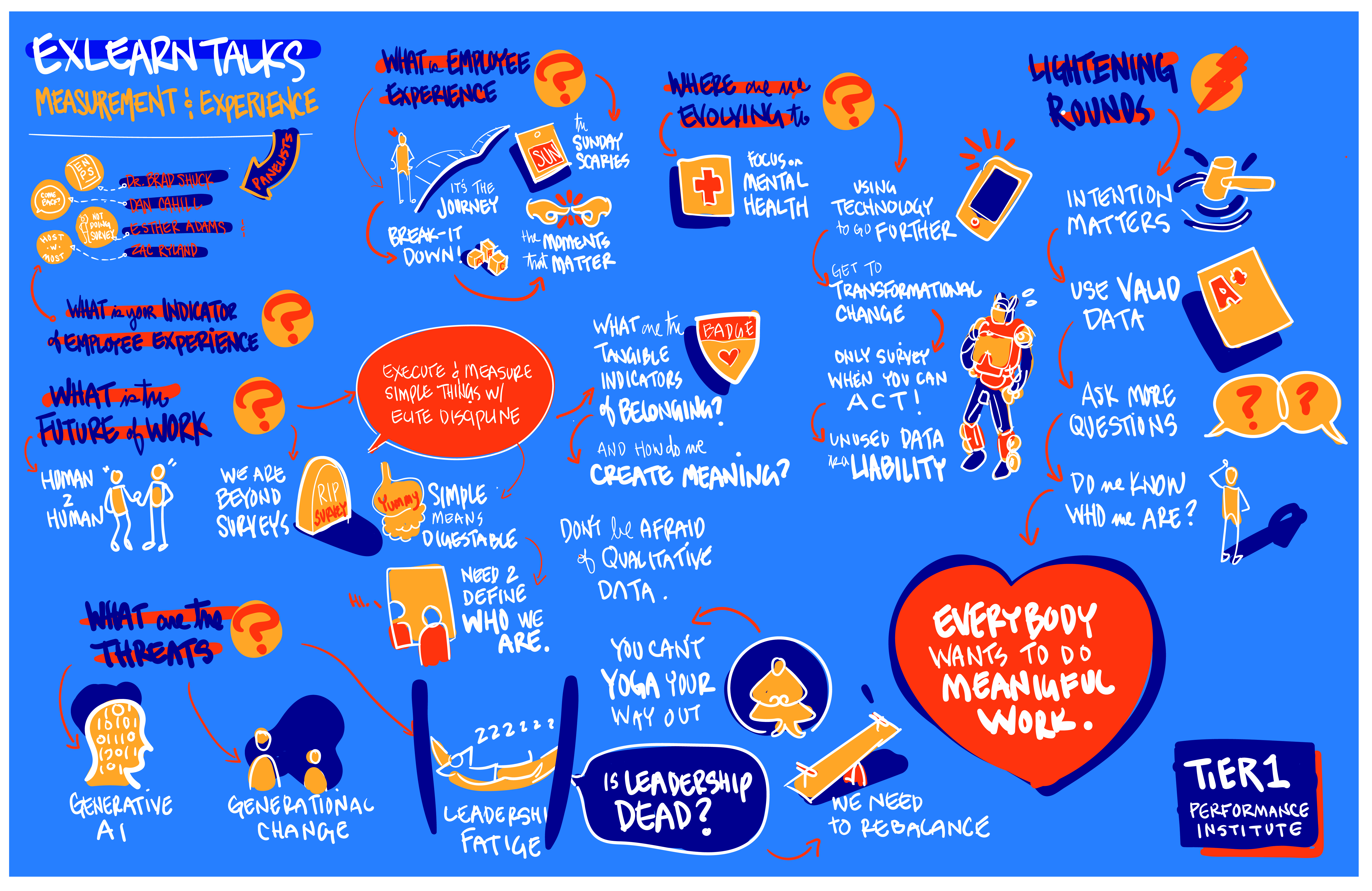
The experts in this EXLEARN Talks episode discuss the nuances of employee engagement and the evolution of measuring engagement in organizations. They provide insight on the following questions:
-
- 3:20: If you could only use one indicator to measure employee engagement, what would it be?
- 9:40: How do you define employee experience?
- 14:04: How has your organization’s approach to employee experience evolved over time?
- 19:26: What “simple things” can organizations do to measure engagement?
- 27:16: What environmental barriers make it difficult for organizations to drive engagement?
- 34:27: What new data collection approaches are organizations embracing to measure engagement, and what are they doing with the data?
Highlights from the Panelists:

“It makes me think of that quote ‘Execute simple things with elite discipline.’ Sometimes we see organizations trying to overcomplicate employee experience, and so maybe we can reframe it to ‘Execute and measure simple things with elite discipline.’ A lot of the things that can make a big impact [are] these small moments or small shifts in behavior of the way someone shows up in a one-on-one or in a team meeting or during a performance review that will drastically shift engagement. Sometimes we can think small to achieve big.”
– Esther Adams, Senior Solutions Consultant at TiER1 Performance

“We’ve moved from just data collection and some analysis—[which has] been eased so much because of the technology—and we’re starting to look at things like report development and distribution as part of the solution and moving toward creating fertile ground for change in the organization… We have individuals who are providing more feedback, and they’re becoming more fatigued because they want to see immediate action coming out of their feedback. If we’re going to ask for people’s opinion—which in and of itself is part of the employee experience—we need to be able to respond.”
– Dan Cahill, Managing Principal at HSD Metrics

“What I’m seeing for the future of the field and particularly measurement is the introduction of conversations around wellness and well-being and that’s inclusive of the idea of burnout and compassion fatigue because these are becoming important barometers of how people are experiencing work.”
– Brad Shuck, Professor of Human Resources and Organizational Development at University of Louisville
A Visual Capture of the Discussion:
Designed by Ramsey Ford